
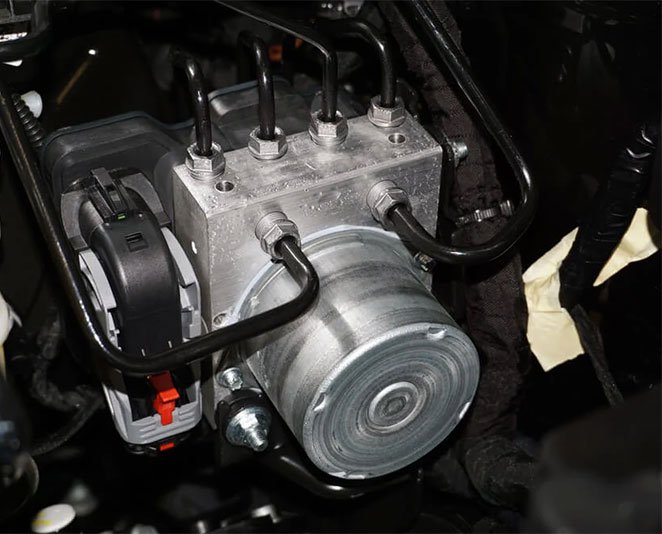
Few automotive failures hit harder than a bad transmission or a malfunctioning ABS system. Both are essential for safe, smooth driving—the transmission transfers engine power to the wheels with the right gear ratios and torque, while the ABS control module (the brain of the anti-lock braking system) prevents wheel lockup during hard stops by pulsing brake pressure rapidly. When either goes bad, the symptoms are unmistakable and impossible to ignore for long.
Transmission problems often announce themselves with slipping (RPMs climb but speed doesn’t), delayed or rough shifts, hesitation when shifting into drive or reverse, whining, grinding, or clunking noises from underneath, burning smell (overheated fluid), visible red/brown fluid leaks under the vehicle, shuddering/vibration during acceleration, or the transmission refusing to engage gears at all. In severe cases, the car may limp along in one gear or not move.
ABS issues show up as an illuminated ABS light (sometimes with brake or traction control warnings), spongy or non-responsive brake pedal, no pulsing sensation during hard braking on slick surfaces, wheels locking up unexpectedly, longer stopping distances, or the system failing to activate when it should (no pedal vibration in panic stops). A faulty ABS control module can disable the entire anti-lock function, increasing skid risk in emergencies—especially dangerous in rain, snow, or gravel.
Replacement costs for these components are steep. A brand-new or remanufactured automatic transmission typically costs $2,000–$5,000+ for the unit alone (higher for trucks, luxury vehicles, or high-performance models), plus $800–$2,000 in labor for removal, installation, fluid flush, and testing. Total bills frequently exceed $3,500–$7,000. For ABS control modules, new OEM replacements run $500–$1,500 (often $800–$1,200 on average), and full replacement—including programming at a dealer or with specialized tools—pushes the total to $1,000–$2,500 or more, depending on the vehicle.
This is precisely why so many owners choose to buy used transmission units and used ABS control modules from salvage sources. These are genuine OEM parts pulled from low-mileage wrecked vehicles—often donors that suffered front-end or side collisions where the transmission or brake electronics remained undamaged and functional. When sourced properly, used transmissions can cost $800–$2,000 shipped (frequently 50–70% less than reman/new), while used ABS modules typically range from $200–$600, delivering massive savings without major compromises in quality or safety.
Real examples illustrate the value. A driver with a 2016 pickup experienced slipping and harsh shifts after towing heavy loads—shop quoted $5,800 for a reman transmission installed. He opted to buy a used transmission from a salvage yard network, finding a tested unit from a 70k-mile donor truck (rear-ended, drivetrain untouched) for $1,350 shipped with a 60-day warranty. Local shop installed it for $1,100—total around $2,450, and the truck has shifted smoothly for thousands of miles since. Similarly, a sedan owner dealt with persistent ABS light and no brake pulsing in stops. Dealer wanted $1,800 for new module and programming. He found a used ABS control module from a low-mileage donor for $320 shipped, plus $450 for install/programming—total under $800, brakes felt secure again.
Why Buying Used Transmission and Used ABS Modules Works So Well
Salvage-sourced used parts aren’t the gamble they once were. Reputable suppliers test thoroughly: transmissions are bench-run or vehicle-tested for smooth shifting, fluid condition (no burnt smell, no excessive debris), solenoid operation, and no major leaks. ABS control modules get hydraulic pump tested, electronic boards scanned for faults, and functionality verified. Many come from gently wrecked vehicles—low miles, no towing abuse for transmissions, no water damage or crashes affecting electronics for ABS units.
Key advantages include:
- OEM authenticity — Factory-matched specs (gear ratios, torque capacity, valve body design for transmissions; exact calibration, connector pins, hydraulic ports for ABS modules).
- Significant cost reduction — Often 50–70% less than new/reman, freeing up money for other maintenance.
- Better availability — Ideal for discontinued parts, older models, or specific configurations (e.g., 6-speed vs 8-speed, certain ABS programming for stability control).
- Warranties and support — Many include 30–90 days coverage; returns accepted if defective or mismatched.
- Environmental benefit — Reusing reduces demand for new manufacturing, cuts resource extraction and emissions, and keeps otherwise good vehicles on the road.
Used transmissions frequently outperform budget reman units because they retain original factory components rather than a patchwork of new and reused parts. Used ABS modules avoid the high cost of new hydraulic/electronic assemblies while delivering the same programmed safety features.
How to Buy and Install These Parts Successfully
Always start with your VIN for precise matching—transmission type (auto/manual, number of speeds, gear ratios, torque rating), ABS module calibration (integrated with traction/stability control, specific software version). Search by make, model, year, engine, and drivetrain details.
Look for listings that provide:
- Donor vehicle mileage and history (prefer under 100k miles)
- Test results (shift quality, voltage/fluid condition for trans; pump/electronic function for ABS)
- Clear multi-angle photos (no visible damage, clean fluid)
- Warranty and return policy details
For transmissions: Professional installation is recommended—flush cooler lines, replace filter/fluid, check mounts/torque converter. Budget $800–$1,500 labor; road-test for smooth operation.
For ABS modules: Often requires dealer-level programming or scan tool to sync with the vehicle. Install includes bleeding brakes, clearing codes, and testing in a safe area. Labor typically $300–$700.
Avoid pitfalls: Skip vague listings without photos/history, extremely low prices with no testing, high-mileage donors, or “core charge” surprises.
Buying used transmission units or used ABS control modules from trusted salvage sources is one of the most effective ways to handle these expensive repairs. You get dependable, OEM-level performance at a fraction of the cost—keeping your vehicle safe, reliable, and on the road without breaking the bank.
Next time your transmission slips or that ABS light glares at you, pull your VIN and explore used options. The right part could save you thousands while restoring full drivability and braking confidence.