
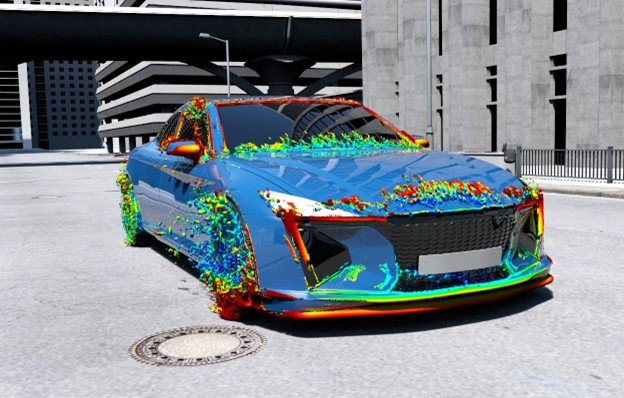
Computational fluid dynamics (CFD) has become an essential technology for engineers, researchers, and organizations that need to understand complex fluid flow, heat transfer, turbulence, aerodynamics, and other physical processes. However, modern CFD models can become extremely demanding when simulations involve complicated geometries, high-resolution meshes, transient conditions, or multiple physical phenomena. This is where CFD simulation high performance computing provides a major advantage. By combining CFD software with powerful computing resources, engineers can perform detailed simulations faster while improving the ability to analyze large and complex engineering problems.
Understanding High Performance Computing in CFD
High Performance Computing (HPC) refers to the use of advanced computing systems containing multiple processors, large memory capacities, high-speed networking, and specialized hardware to solve computationally intensive problems. Instead of depending on a single workstation, an HPC environment distributes computational tasks across multiple CPU cores or computing nodes.
CFD simulations are particularly suitable for HPC because many numerical calculations can be divided into smaller tasks and processed simultaneously. This approach, known as parallel computing, allows engineers to solve larger problems within practical timeframes.
For example, a simple fluid-flow model might run comfortably on a desktop computer. However, a simulation involving millions or billions of mesh elements can require enormous computational resources. HPC makes these demanding calculations more manageable.
Faster CFD Simulation and Reduced Computing Time
One of the most important benefits of CFD simulation high performance computing is speed. Traditional CFD calculations can take hours, days, or even weeks depending on the complexity of the model. HPC can significantly reduce this processing time by distributing calculations across many processor cores.
Parallel processing allows different portions of a computational domain to be solved simultaneously. When the workload is properly distributed, simulations that previously required extensive computing time can be completed much more quickly.
This speed is especially valuable during engineering design. Engineers often need to test multiple design variations before selecting the best solution. Faster simulations allow them to evaluate more alternatives within the same project schedule.
For industries such as automotive engineering, aerospace, energy, manufacturing, and chemical processing, shorter simulation times can contribute to faster product development and more efficient decision-making.
Improving Simulation Accuracy Through Higher Resolution
Speed is not the only advantage HPC provides. Computational resources also influence how detailed a CFD simulation can become. A finer mesh generally allows engineers to capture smaller flow structures, boundary-layer behavior, vortices, pressure variations, and other physical details.
However, increasing mesh resolution dramatically increases the number of calculations required. A conventional workstation may struggle to process an extremely fine mesh efficiently.
With HPC resources, engineers can use larger and more detailed computational meshes. This can improve the representation of complex physical phenomena and provide more detailed simulation results.
For example, aerodynamic analysis around an aircraft or vehicle may require highly refined regions around surfaces, wings, edges, or other components. HPC enables these simulations to use greater computational detail without making the calculation impractically slow.
Handling Complex Engineering Models
Modern CFD applications frequently involve more than basic fluid flow. Engineers may need to analyze turbulence, combustion, multiphase flow, conjugate heat transfer, fluid-structure interaction, radiation, or chemical reactions.
Each additional physical model introduces more equations and computational requirements. HPC provides the processing capacity necessary to handle these increasingly complex simulations.
A large industrial system may also contain complicated geometry that requires millions of mesh elements. HPC makes it possible to simulate the entire system instead of simplifying the geometry excessively.
This capability helps engineers obtain a more realistic understanding of how a design will perform under actual operating conditions.
Scalability for Large CFD Projects
Another major benefit of CFD simulation high performance computing is scalability. Scalability means that computational resources can be increased as simulation requirements grow.
A project may begin with a relatively small model running on a few processor cores. As the project develops, engineers may need a finer mesh, longer simulation periods, additional physical models, or multiple simulation cases. An HPC environment can provide additional processing resources to accommodate these requirements.
Cloud-based HPC platforms can make scalability even more flexible. Organizations can access additional computing capacity when demand increases rather than maintaining all hardware internally.
This approach can be particularly useful for companies that experience fluctuating computational workloads.
Supporting Design Optimization
Engineering optimization often requires running numerous CFD simulations. A designer may need to compare different geometries, operating conditions, materials, or system configurations.
Running these cases sequentially on a standard computer can consume considerable time. HPC enables multiple simulations to be executed concurrently, making optimization studies significantly more practical.
For instance, an engineer optimizing an airfoil might test dozens or hundreds of geometry variations. Each design can be evaluated using CFD, while HPC resources process multiple cases simultaneously.
The resulting data can then be compared to identify designs that offer improved efficiency, reduced drag, better cooling, or other desired performance characteristics.
HPC and Transient CFD Simulations
Steady-state CFD simulations can already require substantial computing resources, but transient simulations can be even more demanding. In transient CFD, engineers study how fluid behavior changes over time.
Applications include combustion processes, rotating machinery, vehicle aerodynamics, wave propagation, ventilation, and rapidly changing industrial flows.
A transient model may require thousands of time steps, with the governing equations solved repeatedly at every step. HPC helps reduce the computational burden associated with these calculations.
By accelerating transient simulations, engineers can investigate time-dependent flow behavior in greater detail and complete studies within reasonable project schedules.
Better Resource Utilization
HPC environments can also improve resource utilization. Modern simulation platforms can distribute workloads among available processors, allowing computational resources to work together rather than leaving much of the available processing capacity unused.
Efficient parallelization depends on the CFD solver, mesh decomposition, communication between processors, and the characteristics of the simulation. Properly configured systems can deliver substantial performance improvements.
However, simply adding more processors does not always produce proportional speed increases. Engineers must consider parallel efficiency, memory requirements, network performance, and workload distribution when designing an HPC environment.
Reducing Engineering Development Costs
Although HPC infrastructure requires investment, faster simulations can produce long-term economic benefits. Engineers can complete more studies in less time, identify design problems earlier, and reduce dependence on expensive physical prototypes.
CFD does not completely eliminate experimental testing, but it can reduce the number of physical prototypes needed during development. Virtual testing allows engineers to investigate potential designs before manufacturing them.
As simulation capabilities become more advanced, organizations can use HPC to support digital engineering workflows that combine simulation, optimization, data analysis, and experimentation.
The Future of CFD and HPC
The relationship between CFD and HPC will continue to grow as engineering models become more sophisticated. Increasingly detailed simulations require greater computational power, while modern processors, accelerators, cloud platforms, and improved numerical algorithms continue to expand what engineers can accomplish.
Artificial intelligence and machine learning may also complement CFD and HPC by helping engineers identify patterns in simulation data, create reduced-order models, and accelerate certain aspects of engineering analysis.
Ultimately, CFD simulation high performance computing provides the foundation for solving larger, more detailed, and more complex fluid-dynamics problems. By improving computational speed, supporting higher-resolution models, enabling scalable resources, and facilitating large optimization studies, HPC helps engineers extract greater value from CFD.
For organizations working with demanding simulations, the combination of advanced CFD software and HPC can transform simulation from a time-consuming computational task into a practical tool for faster innovation, more informed engineering decisions, and increasingly accurate virtual testing.